
SAP ACS Warranty Management: Architecture, Process, and Implementation Guide
Why Warranty Management Matters
Warranty expense is one of the largest uncontrolled costs in many manufacturing companies. Global automakers alone paid more than $50 billion in warranty claims in 2023, according to industry research from Warranty Week. Across the sector, warranty expenses average about 2.5% of revenue, and in difficult product years some manufacturers see warranty costs exceed 4% of sales.
Yet despite the financial scale, warranty operations in many organizations still run with limited visibility into the true drivers of those costs.
What Is SAP ACS Warranty Management
Most enterprise ERP systems can record warranty claims. Few can manage the entire warranty ecosystem.
SAP ACS Warranty Management was developed to address that gap. The solution extends the standard warranty capabilities in SAP by connecting claim processing, supplier recovery, financial settlement, and warranty analytics into a single operational workflow.
At its core, the system manages the full lifecycle of a warranty claim.
A claim typically begins when a dealer or service center submits a repair request for a product still under warranty. The system checks entitlement rules to determine whether the repair qualifies for coverage. If the claim is approved, SAP records the repair cost, labor, and parts associated with the service event.
What makes the SAP ACS warranty management solution different is how it handles the next step: determining responsibility for the cost.
Many product failures originate from supplier components rather than the final manufacturer. When that happens, the manufacturer may have the contractual right to recover part or all of the warranty expense from the supplier. SAP ACS Warranty Management automates that recovery process by linking warranty claims with supplier contracts, part traceability data, and recovery rules.
The platform also standardizes how claims are evaluated. Instead of relying on manual reviews, organizations can apply predefined policies that determine whether claims should be approved, rejected, or partially reimbursed. This reduces processing time while ensuring claims are handled consistently across global dealer networks.
From a systems perspective, the solution operates inside the broader SAP environment. Warranty claims connect directly to service orders, logistics transactions, and financial postings in SAP S/4HANA. Warranty data can then flow into reporting platforms such as SAP BW or SAP Analytics Cloud, where engineering and operations teams analyze product failure trends.
For manufacturers with large installed product bases, the result is a unified warranty system that links four critical functions:
-
Claim submission and validation.
-
Repair and service execution.
-
Supplier recovery management.
-
Warranty cost analytics
Instead of treating warranty as an isolated administrative process, the system turns warranty data into operational intelligence that improves product quality, supplier accountability, and financial control.
SAP Warranty Management Architecture
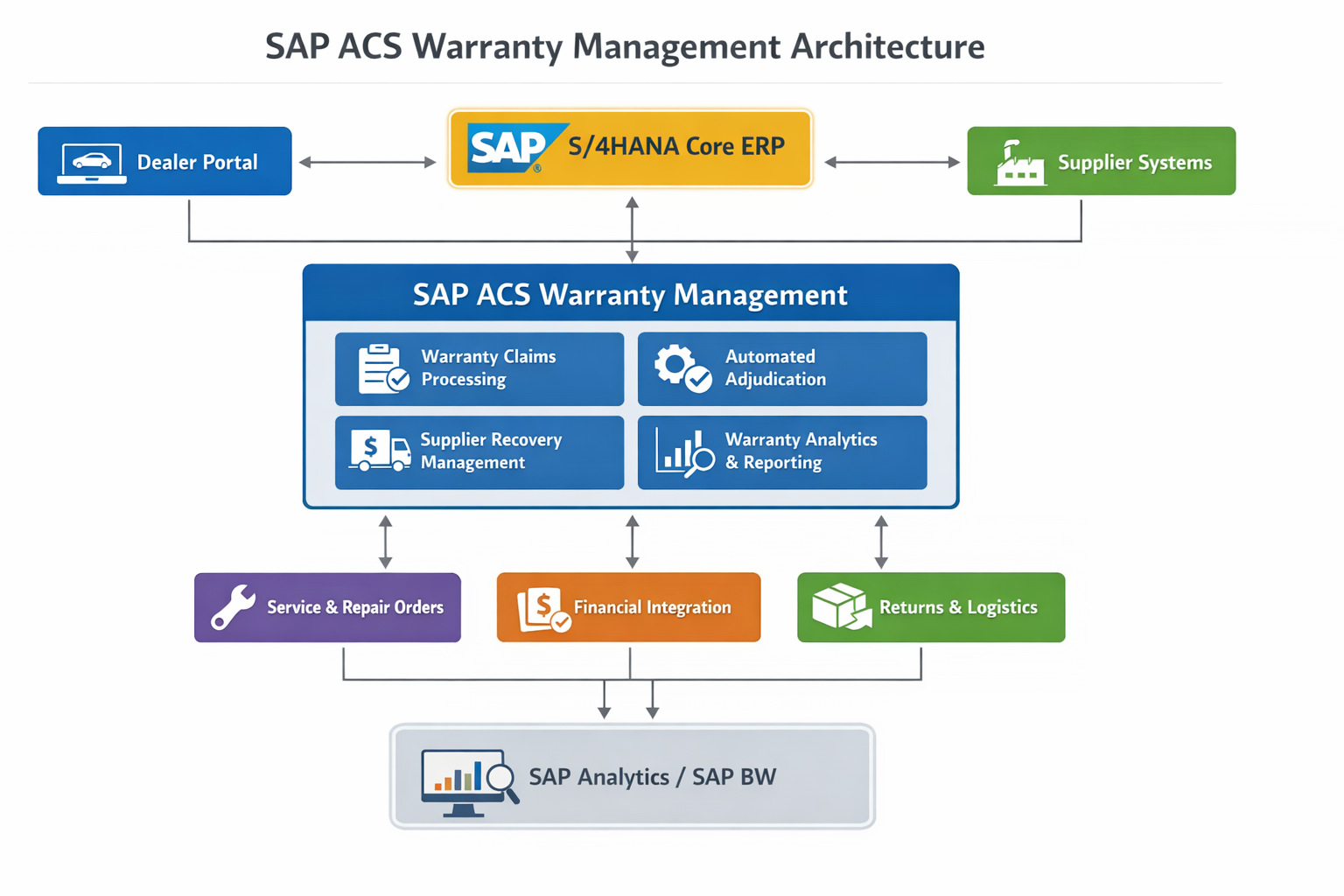
Figure: SAP Warranty Management Architecture
Dealer networks submit claims that flow through entitlement validation, service processing, supplier recovery, financial settlement, and warranty analytics within the SAP S/4HANA ecosystem.
Warranty management touches more parts of the enterprise system than most executives expect.
A single warranty claim can involve dealer systems, service operations, logistics, supplier contracts, and financial postings. When those activities run in separate systems, warranty programs become slow, inconsistent, and difficult to analyze.
The SAP warranty architecture was designed to bring those activities together inside the core ERP environment.
At the center of the architecture sits SAP S/4HANA, which manages the operational transactions tied to warranty events. Service orders record the repair activity. Logistics processes manage replacement parts and returns. Financial modules handle the accounting entries tied to claim payments and supplier recoveries.
SAP’s warranty functionality is built as a cross-application capability integrated with multiple ERP modules, including materials management, service management, pricing, and financial accounting. This allows warranty claims to connect directly with master data, service orders, pricing logic, and financial postings across the enterprise system.
SAP ACS Warranty Management sits on top of this operational layer. The ACS components manage the specialized processes required for large-scale warranty programs. These include claim intake, entitlement validation, rule-based claim evaluation, and supplier cost recovery.
Dealer networks typically interact with the system through a portal or dealer management system. Dealers submit warranty claims that include repair information, parts replaced, labor hours, and supporting documentation. The claim data enters the SAP warranty workflow where entitlement rules verify whether the product is still under warranty and whether the repair qualifies for reimbursement.
Once validated, the system connects the claim to the service transaction that performed the repair. Parts used in the repair are recorded through SAP logistics processes, and labor costs are captured through the service order.
The next layer of the architecture handles financial responsibility. If a defective component originates from a supplier, the system can generate supplier recovery claims based on contractual agreements and component traceability data. SAP documentation describes this process as creating reimbursement requests to suppliers, including detailed information on parts, labor, and repair costs associated with the claim.
The final layer of the architecture focuses on analytics. Warranty data flows into reporting platforms such as SAP BW or SAP Analytics Cloud or even ChatACS, where organizations analyze failure rates, supplier performance, and warranty cost trends. These insights allow engineering and operations teams to perform warranty data analysis to identify recurring product defects and evaluate supplier quality across large installed product bases.
When these components operate together, the architecture connects the entire warranty lifecycle:
-
Dealer claim submission
-
Warranty entitlement validation
-
Service repair execution
-
Supplier recovery processing
-
Financial settlement
-
Warranty analytics
The practical effect is that warranty stops being an isolated service activity. It becomes part of the operational data model of the enterprise system, allowing leadership to track product quality, supplier performance, and warranty exposure in near real time.
According to SAP documentation, warranty claim processing integrates service orders, logistics transactions, and financial postings within the S/4HANA platform (SAP Help Portal).
End-to-End Warranty Process in SAP
Warranty claims move through several operational systems before the financial impact ever reaches the income statement. When those steps are disconnected, claims take longer to process, supplier recoveries are missed, and warranty data becomes difficult to analyze.
SAP connects these activities into a structured workflow that follows the lifecycle of a warranty event from the moment a repair is reported to the point where the data is analyzed for product quality insights.
The process typically unfolds in six stages.
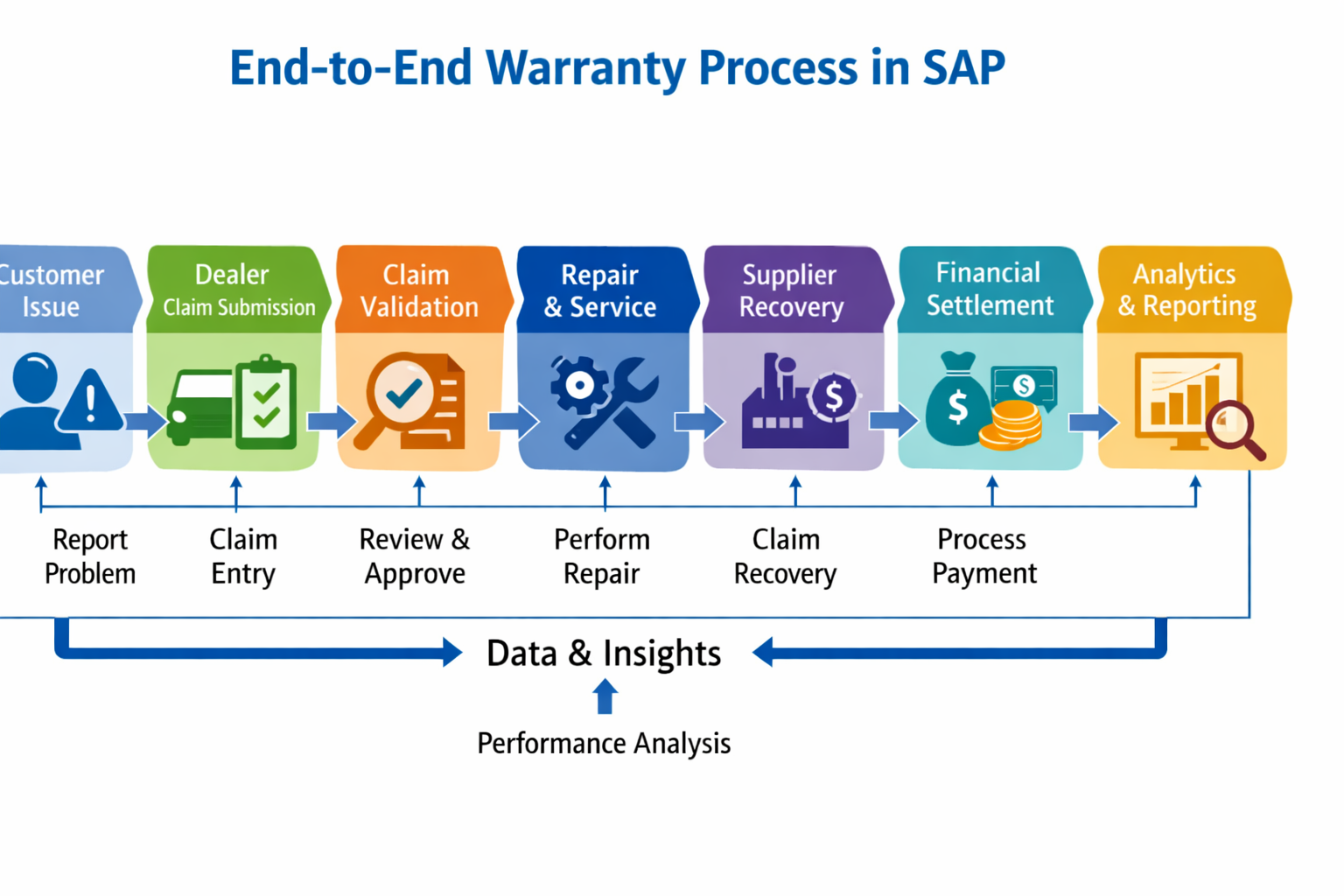
Figure: End-to-End Warranty Process in SAP
Dealer claims flow through entitlement validation, service execution, supplier recovery, financial settlement, and warranty analytics within the SAP environment.
Claim submission begins the cycle. Dealers or service centers report a failure and submit a warranty claim that includes the product identifier, repair details, parts replaced, labor hours, and supporting documentation. In many organizations this information enters SAP through a dealer portal or integrated dealer management system.
Once the claim enters the system, entitlement validation determines whether the repair qualifies for warranty coverage. The system checks warranty rules tied to the product, serial number, installation date, and contract terms. If the product falls within the warranty period and the repair conditions meet the policy requirements, the claim moves forward for processing.
The next step connects the claim to the actual service activity. A service order records the repair work performed, including the technician’s labor time and the replacement components used in the repair. This step ties warranty activity directly to operational service records inside SAP.
After the repair is documented, the system evaluates financial responsibility. Many product failures originate from components supplied by external vendors. When traceability data identifies a supplier component as the root cause, the system generates a supplier recovery claim. This allows the manufacturer to recover part or all of the repair cost based on contractual agreements with the supplier.
Financial settlement follows once the claim has been approved. The system records the reimbursement owed to the dealer or service provider and posts the accounting entries associated with the repair cost. At the same time, supplier recovery transactions are recorded to offset the manufacturer’s warranty expense.
The final stage focuses on analysis. Warranty data flows into reporting and analytics platforms such as SAP BW or SAP Analytics Cloud. Engineering, quality, and operations teams use this information to identify failure trends, evaluate supplier performance, and detect recurring product defects across the installed base.
When these six stages operate as a single workflow, warranty activity becomes more than a claims processing function. The organization gains visibility into product reliability, supplier quality, and the operational drivers behind warranty expense.
Key Features of SAP ACS Warranty Management
Manufacturers with large installed product bases process thousands of warranty claims each month. The operational challenge is not simply recording those claims. The real difficulty is determining eligibility, assigning financial responsibility, and identifying product failures early enough to prevent repeated defects.
SAP ACS Warranty Management provides several capabilities that address these operational requirements across dealer networks, suppliers, and internal service organizations.
Claim Processing
Warranty programs begin with the claim itself. Dealers or service centers submit repair requests that document the failure, parts replaced, labor hours, and supporting evidence. The system records the claim and connects it directly to the relevant product, service order, and repair history inside SAP. This creates a traceable record of warranty activity across the installed base.
Automated claim intake and validation
Once submitted, the system evaluates the claim against warranty terms tied to the product configuration, serial number, installation date, and coverage rules. Automating these checks reduces the manual effort required to validate eligibility and prevents claims from progressing if they fall outside defined warranty conditions.
Rule-Based Adjudication
Large warranty programs require consistent decision-making across thousands of claims. Policy-driven adjudication allows organizations to define rules that evaluate claims automatically. These rules can check labor thresholds, repair conditions, or component eligibility. Claims that meet the defined criteria can move forward automatically, while exceptions are flagged for manual review.
Supplier Recovery
Many product failures originate from components supplied by external vendors. When traceability data identifies a supplier component as the root cause of a repair, the system can generate recovery claims tied to supplier contracts. This supplier recovery capability allows manufacturers to recover part or all of the repair expense from the responsible supplier rather than absorbing the cost entirely.
Warranty Cost Analytics
Warranty programs generate large volumes of operational data which can be analyzed using SAP Warranty Reporting and Analytics. By consolidating claims, repairs, and supplier recovery activity in the ERP system, organizations gain visibility into failure trends and cost drivers. Engineering and quality teams can analyze patterns in component failures, geographic repair trends, and supplier performance across the installed product base.
Dealer Network Integration
Manufacturers operating global dealer networks must manage claims originating from many service locations. Integration with dealer portals or dealer management systems allows repair centers to submit claims directly into the warranty workflow. This standardizes claim reporting while providing the manufacturer with consistent visibility into repair activity across the network.
Warranty Analytics and AI
Warranty claims generate one of the most valuable sources of operational data inside a manufacturing company. Every repair performed in the field contains information about product reliability, component performance, and supplier quality. When this data remains isolated in service systems, engineering teams often discover recurring defects months or years after they first appear.
SAP addresses this challenge by linking warranty activity with analytics and quality management processes.
Warranty data collected through claims processing can flow into reporting platforms such as SAP BW or SAP Analytics Cloud. These systems aggregate repair activity across products, geographies, suppliers, and service locations. The resulting data allows leadership to identify patterns that would be difficult to detect from individual claims alone.
Failure trend analysis is one of the most common applications. If a particular component begins to fail more frequently than expected, analytics systems can surface that trend quickly. Engineering teams can then investigate the root cause before the defect spreads across the installed product base.
Supplier performance monitoring is another critical capability. When warranty claims are connected to component traceability data, manufacturers gain visibility into which suppliers are responsible for recurring failures. This information supports supplier quality discussions and helps organizations recover warranty costs tied to defective components.
Integration with SAP Quality Management extends this analysis further. Quality teams can link warranty failures with corrective action processes, inspection records, and product design changes. One method commonly used in this environment is Failure Mode and Effects Analysis (FMEA), which evaluates potential failure scenarios and prioritizes them based on risk and operational impact.
When warranty analytics feed into FMEA and quality management workflows, the organization creates a continuous feedback loop between field performance and product engineering. Failures reported by dealers lead to analytics insights, those insights inform engineering investigations, and the results drive design improvements or supplier corrective actions.
The business impact extends beyond warranty cost reduction. Product reliability directly affects customer satisfaction. When recurring defects are identified earlier and resolved more quickly, customers experience fewer service disruptions and fewer repeat repairs.
For many manufacturers, these improvements influence one of the most visible measures of customer loyalty: Net Promoter Score (NPS). Products that perform reliably in the field generate fewer warranty claims, fewer service visits, and stronger customer trust.
When warranty analytics, quality management, and engineering processes operate as a connected system, warranty data stops being historical paperwork. It becomes a continuous signal that helps organizations improve product design, supplier quality, and customer experience.
Industries That Use SAP ACS Warranty
SAP originally developed the Automotive Consulting Solution (ACS) to address the warranty challenges faced by global automotive manufacturers. Large dealer networks, complex vehicle assemblies, and multi-tier supplier ecosystems created warranty programs that were difficult to manage using standard ERP functionality alone.
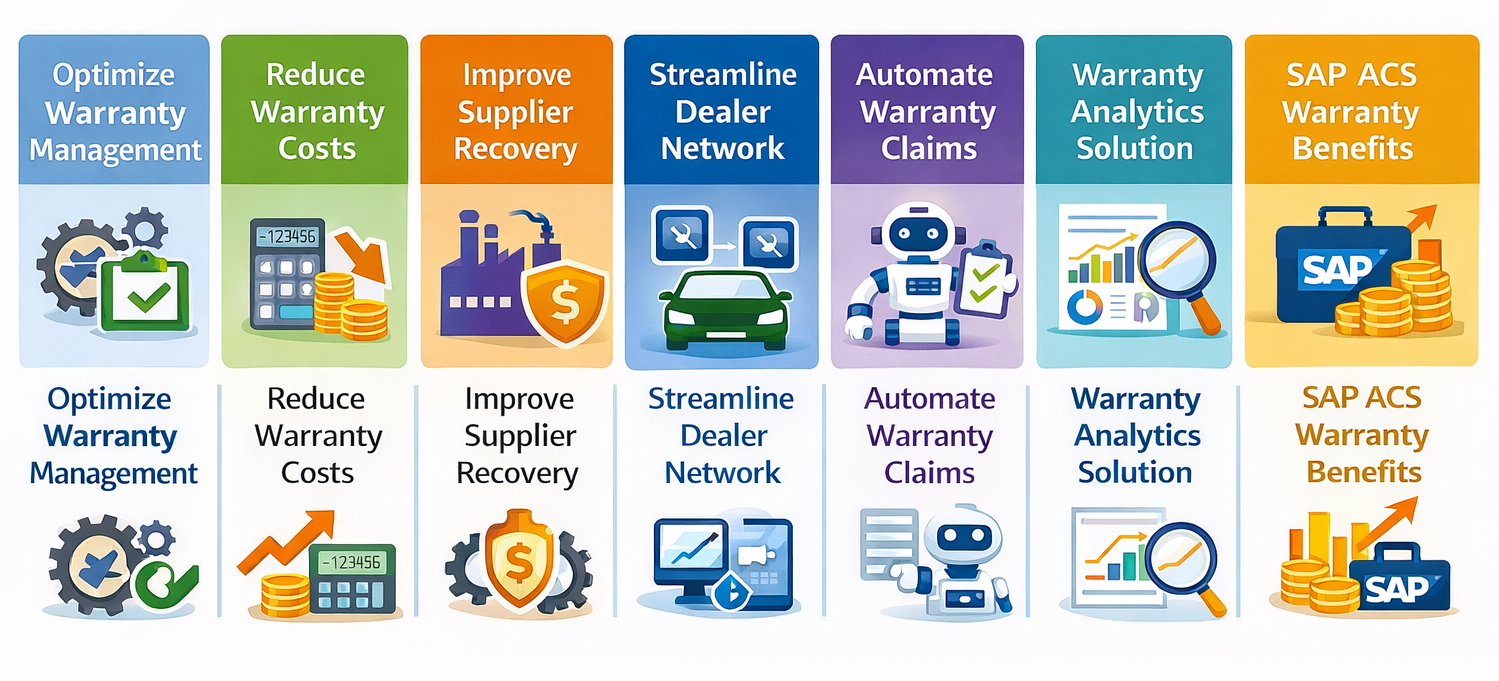
Figure: Industries Using SAP ACS Warranty Management
Automotive, heavy equipment, industrial machinery, consumer electronics, and medical device manufacturers use warranty systems to manage repair activity across complex products and distributed service networks.
Over time, the underlying architecture proved useful well beyond the automotive sector. SAP reports that the broader ACS solution is used by more than 600 customers worldwide, many of which operate in industries where products contain large numbers of components and where repairs are performed through distributed service networks.
Automotive manufacturers remain one of the most visible users of the platform. Vehicle manufacturers manage warranty claims submitted by thousands of dealerships across multiple countries. These claims often involve parts supplied by hundreds of component manufacturers. The system helps coordinate dealer submissions, repair validation, and supplier recovery processes across that ecosystem.
Heavy equipment and industrial machinery companies face a similar challenge. Construction equipment, agricultural machinery, and mining systems operate in demanding environments where component failures can trigger costly field repairs. Warranty systems allow manufacturers to track these failures across the installed base while identifying whether the issue originates from design flaws, manufacturing defects, or supplier components.
Industrial manufacturing companies also use warranty management systems to monitor reliability in complex products such as turbines, industrial pumps, robotics, and precision manufacturing equipment. These products often operate for years or decades, making long-term failure tracking critical for both engineering and service planning.
Consumer electronics manufacturers rely on warranty systems for a different reason: scale. High shipment volumes generate large numbers of warranty claims, and even small product defects can create significant service costs if they affect thousands of units. Warranty analytics helps identify failure patterns quickly so that design corrections can be implemented.
Medical device manufacturers represent another category where warranty management and service tracking intersect. Hospitals and healthcare providers depend on reliable equipment performance, and service events must be documented carefully for both regulatory compliance and quality assurance.
Across these industries, the common factor is product complexity. When products contain hundreds or thousands of components sourced from multiple suppliers, failures in the field are inevitable. Systems like SAP ACS Warranty Management allow manufacturers to manage those failures systematically while improving product reliability over time.
Although the solution originated in the automotive sector, the same operational model applies anywhere manufacturers build complex products, operate global service networks, and rely on supplier ecosystems to deliver critical components.
| Industry | Example Use |
|---|---|
| Automotive | Dealer warranty networks |
| Heavy equipment | Component failure recovery |
| Industrial manufacturing | Supplier chargeback programs |
| Consumer electronics | Product defect tracking |
Implementing SAP ACS Warranty Management
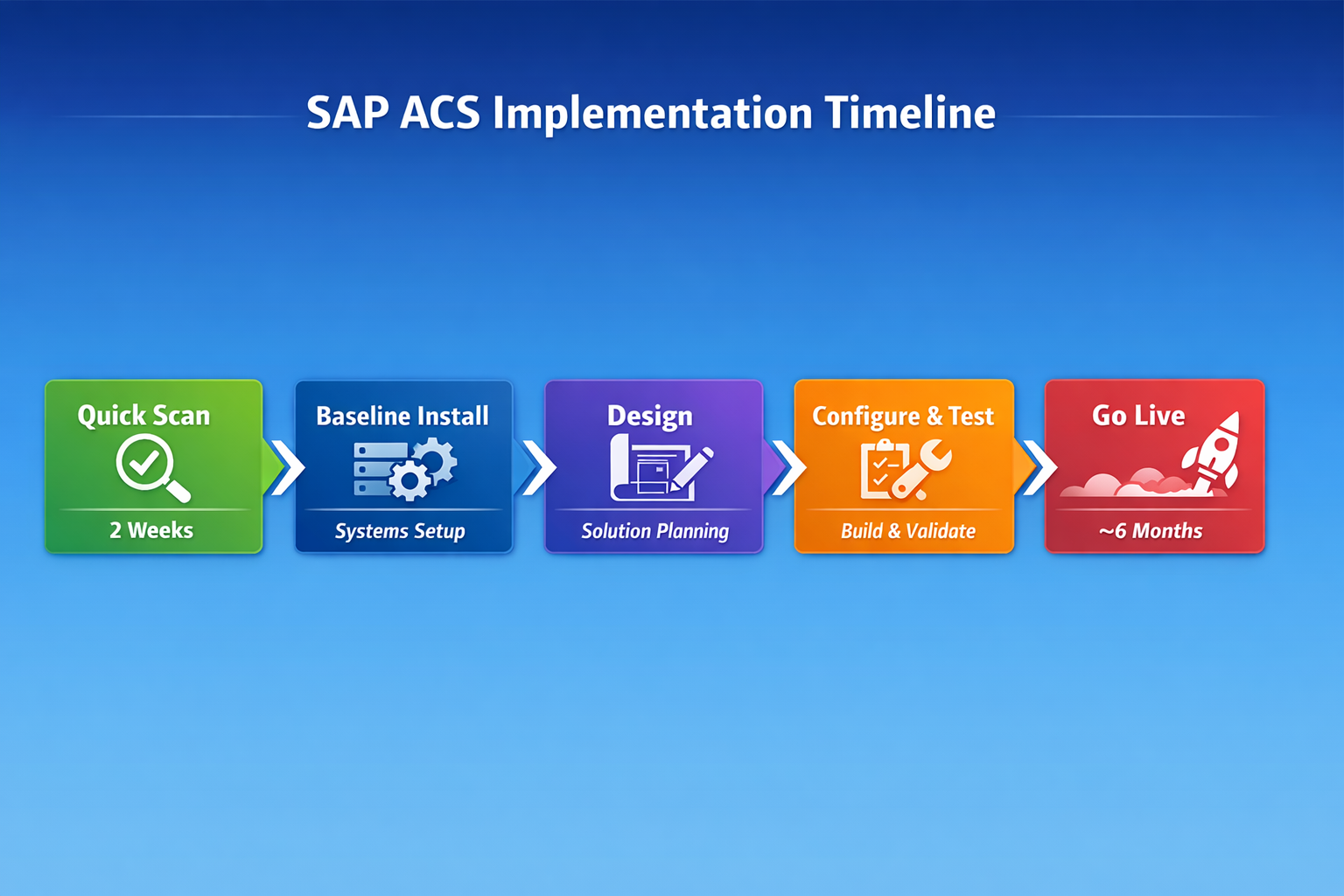
Figure: Typical SAP ACS Warranty Management Implementation Timeline
Enterprise warranty systems affect several parts of the organization at once—service operations, logistics, supplier management, finance, and engineering. Implementations therefore require a structured project approach that coordinates both technical configuration and operational process design.
Most SAP warranty programs follow the SAP ASAP implementation methodology. ASAP (Accelerated SAP) is the standard framework used across many SAP deployments. For SAP ACS Warranty Management, the same structure applies, although the activities are adapted to the specific processes involved in warranty claims, supplier recovery, and dealer network integration.
A typical project begins with a scoping phase known as the SAP Quick Scan workshop. During this engagement, specialists review the client’s existing warranty processes, claim volumes, supplier recovery practices, and dealer network structure. The outcome is a scope document that identifies which ACS components are required and outlines the expected project timeline.
Once the Quick Scan defines the scope, SAP Germany—who provides the SAP ACS solution—performs the initial baseline installation of the software. This preparatory step normally takes about two weeks. The baseline system provides the starting configuration that the project team uses during the implementation.
After the baseline installation is complete, the project moves into the core implementation phases.
Discovery and requirements
The project team reviews the findings from the Quick Scan and works with business stakeholders to confirm detailed requirements. This stage focuses on understanding current warranty workflows, dealer claim processes, supplier recovery agreements, and reporting needs.
Solution design
During this phase, the project team translates business requirements into a system design. Warranty policies, claim validation rules, supplier recovery processes, and reporting structures are defined. Integration points with service orders, logistics transactions, and financial postings are also established.
Configuration and development
The implementation team configures the ACS components inside the SAP environment and develops any required enhancements. Some developments appear during this phase when operational details surface that were not fully captured during the Quick Scan scoping workshop.
Testing and validation
Once configuration is complete, the system is tested using realistic warranty claim scenarios. Dealers, service teams, finance personnel, and quality engineers validate that claims flow correctly through the warranty process and that supplier recovery and financial settlement operate as expected.
Deployment and training
The final phase prepares the organization for production use. Users are trained, warranty policies are finalized, and the system is deployed to the production environment.
Project timelines vary depending on the complexity of the organization. Factors such as the number of dealer locations, the availability of internal client resources, and the amount of custom development required can influence the schedule.
In many cases, however, implementations are measured in months rather than years. On a recent project managed using this approach, the full implementation—from baseline installation through production deployment—was completed in six months, consistent with the timeline established during the scoping phase.
The objective of the implementation is not simply installing software. The goal is to establish a system that allows the organization to manage warranty claims consistently, recover supplier costs accurately, and generate the operational data required to improve product reliability over time.
Business Case and ROI
Warranty costs rarely appear as a single line item that draws attention. They are spread across service operations, parts consumption, labor, supplier disputes, and financial adjustments. As a result, many organizations underestimate both the total cost of warranty programs and the opportunity to reduce that cost.
In industries such as automotive and heavy equipment, warranty expense often ranges between two and four percent of revenue. For large manufacturers, that translates into tens or hundreds of millions of dollars each year. Even small improvements in how warranty is managed can produce meaningful financial impact. In real-world deployments, we have seen almost immediate improvements in supplier recovery rates.
The business case developed during a warranty assessment workshop for SAP ACS Warranty Management typically centers on three areas:
-
Cost recovery.
-
Operational efficiency.
- Product improvement.
The first driver is supplier recovery - a key process to recover warranty costs. Many warranty claims originate from components supplied by external vendors. Without a structured process, those costs are often absorbed by the manufacturer. When warranty claims are connected to supplier contracts and component traceability, organizations can recover a portion of those costs. For companies with complex supplier networks, this alone can represent a significant financial opportunity.
The second driver is consistency in claim processing. Manual review processes lead to variability in how claims are approved, rejected, or partially reimbursed. Over time, that inconsistency increases warranty leakage. Policy-driven adjudication reduces that variability and improves control over how claims are handled across dealer networks.
The third driver is speed. When claim validation and adjudication are automated, processing times decrease. Faster processing reduces administrative overhead and improves dealer satisfaction, which can be important for organizations that rely on independent service networks.
Beyond these operational improvements, the largest long-term impact comes from product quality.
Warranty data reflects real-world product performance. When that data is analyzed systematically, recurring defects can be identified earlier. Engineering teams can then address root causes before failures scale across the installed base. Over time, this reduces both warranty claims and the cost associated with them.
This creates a compounding effect. Fewer defects lead to fewer claims. Fewer claims reduce service costs. Improved reliability strengthens customer satisfaction and reduces repeat service events.
For many organizations, these improvements are reflected in customer loyalty metrics such as Net Promoter Score. Products that require fewer repairs tend to produce fewer complaints and higher levels of customer trust.
The return on investment therefore comes from multiple sources:
-
Reduced warranty leakage
-
Increased supplier cost recovery
-
Lower administrative processing effort
-
Faster claim resolution
- Improved product reliability
- Higher customer satisfaction and retention
Project economics vary based on organizational complexity. Factors such as the number of service locations, the scale of the installed product base, and the level of process standardization all influence the outcome.
However, organizations that approach warranty as an operational system rather than an administrative task often find that the financial benefits extend well beyond the original implementation scope. The system not only reduces current costs but also provides the data required to prevent future costs from occurring.
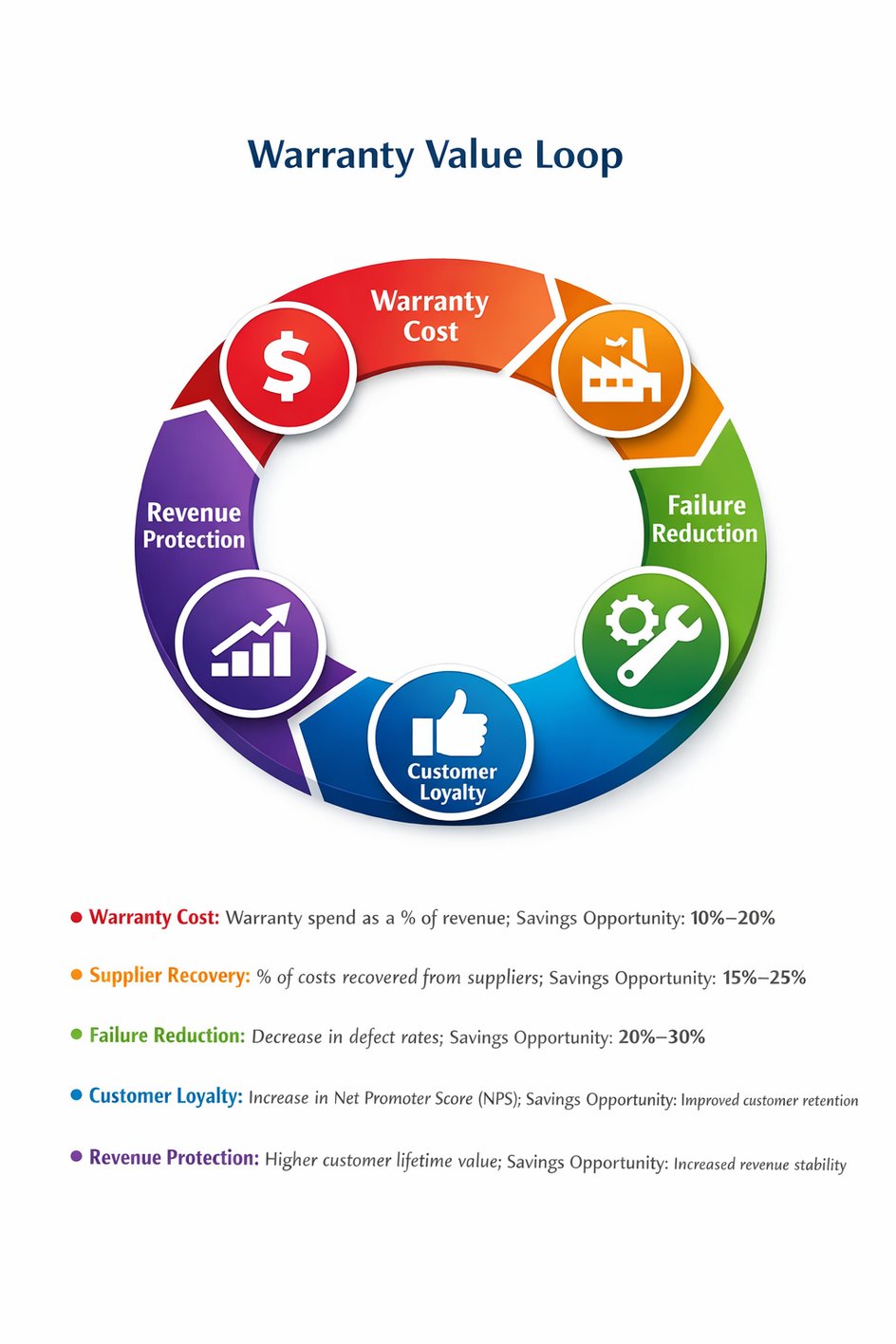
| Stage | KPI to Track | Typical Opportunity |
|---|---|---|
| Warranty Cost | Cost per claim | 5–15% reduction |
| Supplier Recovery | % recovered | +10–30% improvement |
| Failure Reduction | Repeat failure rate | 10–25% reduction |
| NPS | Customer satisfaction | +5–15 points |
| Revenue Protection | Customer retention | Significant long-term impact |
Common Challenges in Warranty Programs
Warranty programs tend to evolve over time rather than being designed as integrated systems. As product lines expand, dealer networks grow, and supplier ecosystems become more complex, the warranty process often becomes fragmented across multiple teams and systems.
Several patterns appear consistently across organizations.
Fragmented data
Warranty information is often spread across service systems, dealer submissions, spreadsheets, and financial records. When data is not centralized, it becomes difficult to trace a claim from the original repair through supplier recovery and final financial settlement. This lack of visibility makes it harder to identify cost drivers and recurring defects.
Inconsistent claim handling
In many organizations, warranty claims are reviewed manually. Different teams may apply different interpretations of warranty policies, leading to inconsistent outcomes. Over time, this creates warranty leakage, where claims are approved that should have been rejected or partially reimbursed.
Limited supplier recovery
Supplier recovery is one of the most underutilized areas in warranty programs. Even when contracts allow recovery, organizations often lack the traceability and process discipline required to pursue those claims consistently. As a result, manufacturers absorb costs that should be shared with suppliers.
Slow feedback to engineering
Warranty claims contain early signals of product defects, but those signals are often delayed or diluted before reaching engineering teams. When failure data is not analyzed quickly, defects can persist across multiple production cycles, increasing both warranty costs and customer dissatisfaction.
Dealer network variability
Global dealer networks introduce additional complexity. Dealers may use different systems, follow different processes, and provide varying levels of detail in claim submissions. Without standardized workflows, the quality and consistency of warranty data can vary significantly across regions.
Lack of end-to-end ownership
Warranty processes typically span multiple departments, including service, finance, procurement, and engineering. When ownership is unclear, no single group is responsible for optimizing the entire lifecycle. This leads to gaps between claim processing, supplier recovery, and analytics.
These challenges share a common theme. Warranty programs are often treated as administrative processes rather than as integrated operational systems.
Organizations that address these issues systematically—by standardizing processes, connecting data, and aligning warranty with quality and engineering—tend to reduce costs, improve supplier accountability, and respond more quickly to product issues in the field.
Frequently Asked Questions
What is SAP ACS Warranty Management?
SAP ACS Warranty Management is an extension of standard SAP warranty functionality designed for manufacturers with complex products and dealer networks. It manages the full warranty lifecycle, including claim submission, entitlement validation, repair tracking, supplier recovery, financial settlement, and warranty analytics within the SAP environment.
How does SAP Handle Warranty Claims?
SAP processes warranty claims as part of an integrated workflow. Claims are submitted by dealers or service centers, validated against warranty rules, linked to service orders, and recorded in the system with associated parts and labor costs. The system then determines whether the claim is approved and whether any portion of the cost can be recovered from suppliers.
Can SAP Automate Supplier Recovery?
Yes. SAP ACS Warranty Management can automate supplier recovery by linking warranty claims to supplier contracts and component traceability data. When a failure is attributed to a supplier component, the system can generate recovery claims and track reimbursement, allowing manufacturers to recover costs that would otherwise be absorbed.
How long does SAP warranty implementation take?
Implementation timelines vary depending on the complexity of the organization, including the number of service locations, product lines, and required system integrations. Specific implementation timelines are typically determined during a SAP Warranty Quick Scan. A typical approach includes a two-week baseline installation followed by a structured implementation using the SAP ASAP methodology. In many cases, full deployment can be completed in approximately six months.
What industries use SAP warranty management?
SAP warranty solutions are used across industries that manufacture complex products and operate service or dealer networks. These include automotive, heavy equipment, industrial manufacturing, consumer electronics, and medical devices. The common requirement across these industries is the need to manage warranty claims, supplier recovery, and product reliability at scale.
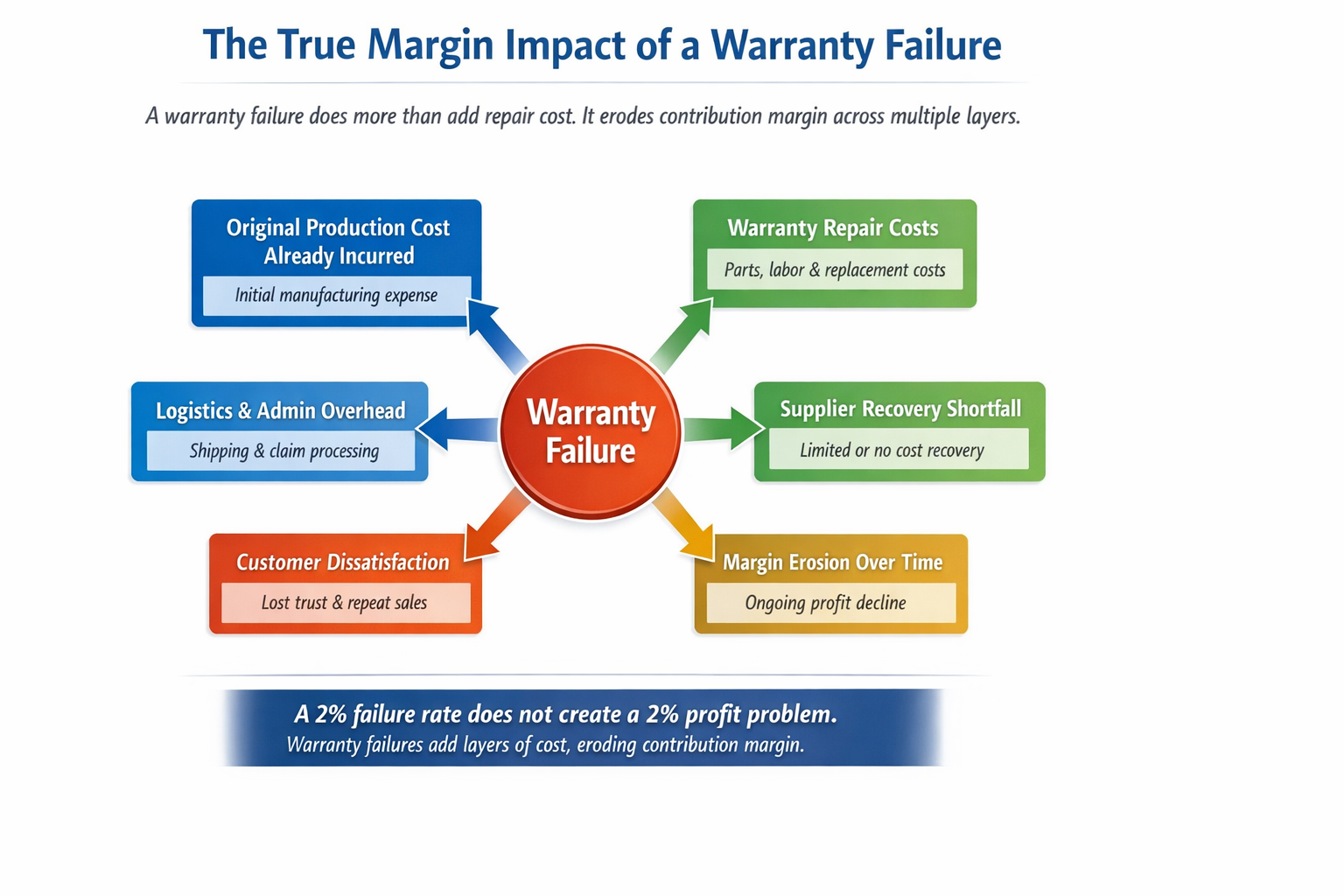
What is the financial impact of warranty failures on contribution margin?
The financial impact of a warranty failure extends beyond the cost of a single repair.
When a product fails, the company absorbs multiple layers of cost: the original cost of goods sold, the cost of warranty repair or replacement, logistics and service labor, and often the cost of managing the claim itself. In addition, supplier recovery may not fully offset these costs.
From a contribution margin perspective, this creates a compounding effect. The company has already incurred the cost to produce and sell the original unit. When that unit fails, additional cost is incurred without generating new revenue. In some cases, a replacement unit must be produced and delivered, further increasing cost exposure.
There is also a longer-term effect. Product failures can lead to customer dissatisfaction, reduced repeat purchases, and increased service burden over time. These factors reduce the effective lifetime value of the customer.
As a result, a two percent failure rate does not translate into a two percent cost impact. The effect on contribution margin is typically higher because each failure introduces additional cost layers and reduces the efficiency of the original sale.
Organizations that reduce failure rates, improve supplier recovery, and shorten time to resolution tend to see a measurable improvement in contribution margin over time.
Next Steps
Most organizations do not need more information about warranty management. They need clarity on where their current process is breaking down and what it would take to fix it.
The first step is not a large project. It is a focused discussion.
You can schedule a working session with Soren Detering to review your current warranty process and identify where the largest opportunities exist. This is not a generic introduction. The objective of the conversation is to provide a clear, practical view of how your organization is currently handling warranty claims and where value can be recovered.
In a typical session, we will discuss:
-
How warranty claims are currently submitted, validated, and processed.
-
Where delays, inconsistencies, or manual effort are affecting performance.
- Whether supplier recovery opportunities are being fully captured.
-
How warranty data is (or is not) being used by engineering and quality teams.
-
What a structured SAP ACS implementation would look like in your environment.
-
The role of SAP ACS Warranty Quick Scan Workshop.
At the end of the discussion, you will have a clearer understanding of:
-
Where warranty costs are being absorbed unnecessarily.
-
Whether a more structured approach would produce measurable financial benefit.
-
What the next step would be if you choose to move forward.
For organizations that decide to proceed, the next phase is the SAP ACS Quick Scan workshop.
The Quick Scan is a structured, short-duration engagement that defines the scope of a potential implementation. It produces a documented view of required functionality, an initial project plan, and a business case based on your actual warranty data and operational model.
Schedule a meeting with Soren Detering to begin the process.
Alternatively, you can complete the assessment form and we will follow up to schedule a discussion.
The objective is simple: provide enough clarity for you to decide whether warranty management is an area worth improving now, or later.