
Recover Lost Profits Hidden Across Suppliers, Warranties, and Financial Processes
Most companies don’t have a cost problem—they have a recovery problem
In one recent SAP warranty environment, less than 60% of eligible supplier claims were ever submitted. Not denied—never submitted. The data was there. The process wasn’t.
That gap shows up in three places:
- Unclaimed supplier reimbursements
- Warranty costs absorbed instead of recovered
- Financial leakage buried in high transaction volumes
Traditional recovery efforts focus on invoice errors. That’s the visible layer. The larger opportunity sits deeper—in supplier accountability, warranty claims, and operational data that never gets turned into recovery dollars.
Built for SAP environments where the data already exists—but the recovery doesn’t
Most SAP systems already contain everything needed to recover these costs:
- Warranty claim data
- Supplier master and contract terms
- Failure codes and service records
- Financial postings tied to claims and materials
The issue isn’t data availability. It’s connecting that data to a repeatable recovery process that actually results in cash coming back.
What Is Cost Recovery Consulting?
Cost recovery is the process of turning missed financial opportunities into realized cash
Cost recovery consulting identifies where money should have been recovered—and wasn’t—then puts a structure in place to claim it.
That includes:
- Overpayments and duplicate invoices
- Contract compliance gaps
- Supplier chargebacks and reimbursements
- Warranty-related recovery tied to product failures
Most firms stop at identifying the issue. The real work starts after that—validating claims, engaging suppliers, and ensuring recovery actually hits the P&L.
Why Most Companies Miss Millions in Recoverable Costs
The failure isn’t analytical. It’s operational.
Across large SAP environments, the same patterns show up:
- Claims require data from multiple modules (FI, MM, SD, PM).
- Ownership sits across departments (finance, operations, service).
- Supplier agreements are not systematically enforced.
- No closed-loop process exists from detection → claim → recovery.
The result: recoverable costs accumulate quietly over time.
Not because companies don’t care—but because no one owns the full recovery lifecycle.
The Four Types of Cost Recovery Every Enterprise Should Understand
Accounts Payable and Overpayment Recovery
This is where most companies start—and where most recovery firms stay.
The focus is straightforward:
- Duplicate payments.
- Pricing discrepancies.
- Missed credits or rebates.
- Invoice errors.
Firms like PRGX and Connolly built their business here. The model works because transaction volumes are high and errors are predictable.
Typical recovery range: 0.1% to 0.5% of spend
It’s valuable—but limited. Once these audits are complete, the opportunity largely resets unless the same errors repeat.
Contract and Compliance Recovery
This layer moves beyond invoices into whether suppliers are actually honoring agreements.
Common gaps include:
- Missed volume discounts.
- Incorrect pricing tiers.
- Unapplied rebates or incentives.
- Service level penalties never enforced.
The challenge is not identifying the contract terms—it’s linking them to actual transactions and enforcing them consistently.
Typical recovery range: 0.5% to 1.5% of applicable spend
Most organizations have the contracts. Few have a system that enforces them at scale.
Warranty and Supplier Recovery (Where the Largest Opportunities Exist)
This is where cost recovery shifts from transactional to operational—and where the largest dollars typically sit.
In manufacturing and OEM environments:
- Failed components should trigger supplier reimbursement.
- Warranty claims should be passed upstream.
- Root cause data should support recovery claims.
In practice, this breaks down:
- Claims are never submitted.
- Supporting data is incomplete.
- Supplier accountability is inconsistent.
- Recovery is treated as optional, not systematic.
In several SAP environments, we’ve seen 30%–50% of eligible warranty recovery never pursued.
This is not an audit problem. It’s a process problem.
And it’s where most traditional recovery firms have no capability.
Pricing, Rebates, and Commercial Recovery
This category sits between finance and commercial operations.
It includes:
- Missed customer rebates.
- Pricing mismatches across channels.
- Promotional funding not claimed.
- Distributor or dealer-related recovery gaps.
The complexity comes from:
- Multiple pricing structures.
- Channel-specific agreements.
- Data spread across sales and finance systems.
Typical recovery range: 0.5% to 2% of revenue in affected segments.
These are often written off as “noise” when they are, in fact, systematic.
Why most cost recovery programs stop too early
Most organizations address the first category—accounts payable—and assume the job is done.
That leaves the larger opportunities untouched:
- Supplier recovery tied to operations.
- Warranty recovery tied to product performance.
- Commercial recovery tied to pricing execution.
The pattern is consistent:
The deeper the recovery opportunity sits in the business, the less likely it is to be captured.
That is exactly where a structured, SAP-driven recovery program changes the outcome.
Why Supplier and Warranty Recovery Is the Next Frontier of Cost Recovery
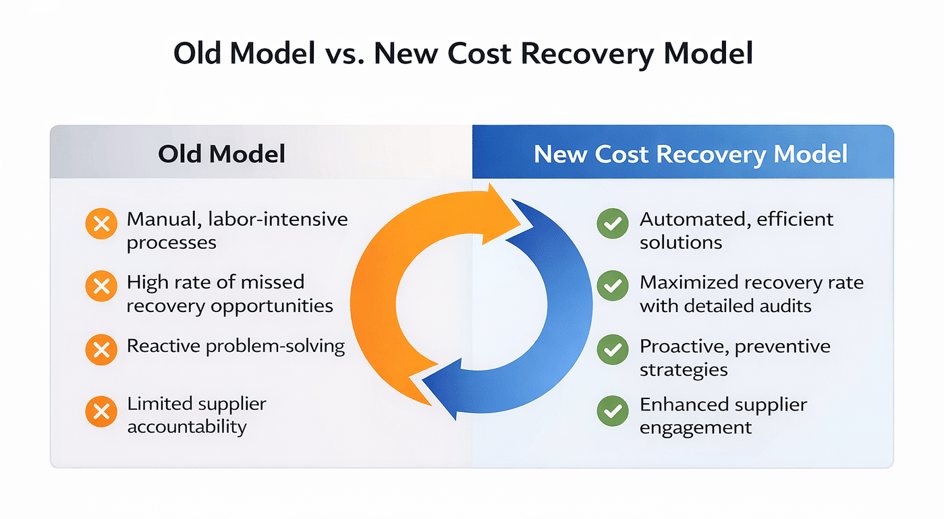
Most recovery programs focus on invoices. The real losses sit in operations.
Invoice audits catch errors after the fact. They don’t address why the cost existed in the first place—or whether it should have been absorbed at all.
In manufacturing and service environments, a large share of recoverable cost originates here:
- Component failures tied to specific suppliers.
- Warranty claims that should be reimbursed upstream.
- Service and repair costs linked to defective parts.
- Field issues that never translate into supplier accountability.
These are not accounting errors. They are operational events with financial consequences.
When those events are not connected to a recovery process, the cost stays on your books.
From Transactional Audits to Strategic Recovery Programs
A traditional recovery audit is periodic. It looks backward.
Supplier and warranty recovery requires something different:
- Continuous identification of recoverable events.
- Standardized claim creation and validation.
- Clear ownership across functions.
- Ongoing supplier engagement tied to real data.
Without that structure, recovery depends on individual effort—and individual effort does not scale.
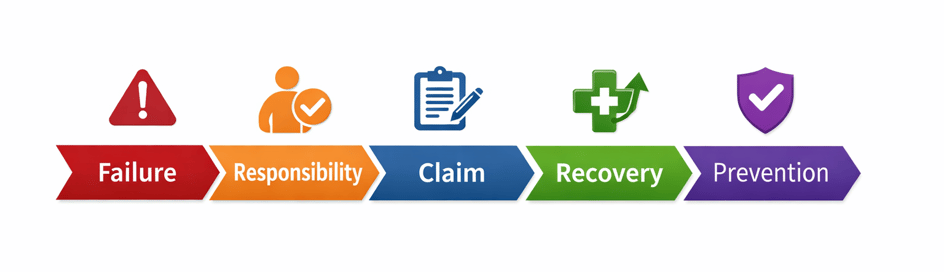
What changes outcomes is not better reporting. It’s a system that connects:
failure → responsibility → claim → recovery → prevention
Why multi-echelon supplier networks make recovery harder—and more valuable
n many SAP-driven enterprises, the supply chain is layered:
- Tier 1 suppliers.
- Tier 2 and Tier 3 component providers.
- Distributors and service partners.
When a failure occurs, responsibility is not always obvious. Data is split across systems. Ownership is unclear.
The default outcome is predictable:
the cost gets absorbed.
When recovery is structured properly:
- Responsibility is traced across tiers.
- Claims are supported with actual operational data.
- Recovery becomes part of supplier performance management.
The more complex the network, the greater the recovery opportunity.
Where traditional recovery firms fall short
Most recovery providers are built around financial transactions:
- They analyze invoices.
- They identify discrepancies.
- They return overpayments.
They are not designed to:
- Interpret warranty data.
- Connect operational failures to supplier liability.
- Work inside SAP warranty and service processes
- Drive recovery across engineering, service, and procurement
That gap is exactly where the largest recovery opportunities sit.
What changes when recovery is treated as a core business process
When supplier and warranty recovery is structured correctly, three things happen:
- Recovery becomes predictable, not occasional.
- Suppliers are held accountable based on data, not negotiation.
- Root causes are identified and reduced over time.
The financial impact is immediate. The operational impact compounds.
Cost recovery stops being a one-time effort and becomes part of how the business runs.
Our Cost Recovery Consulting Process
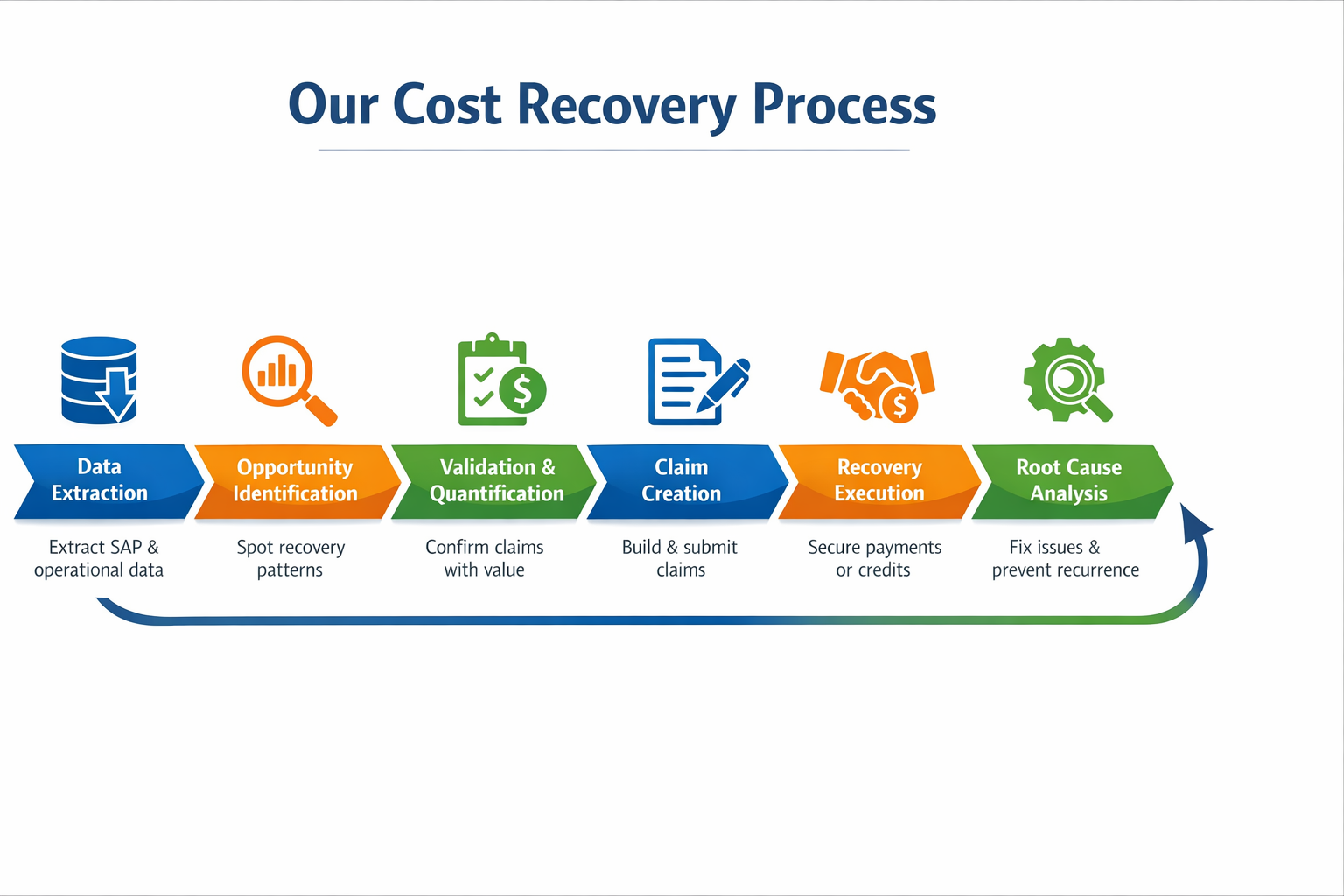
Step 1: Data Extraction from SAP and Related Systems
Recovery starts with pulling the right data—not all data.
In most SAP environments, relevant information sits across:
- FI (financial postings).
- MM (materials and purchasing).
- SD (sales and distribution).
- PM / CS (service, maintenance, warranty data).
The objective is not to create another report. It’s to isolate:
- Transactions tied to potential recovery.
- Warranty and failure events.
- Supplier-linked cost drivers.
If the extraction is too broad, nothing gets actioned. If it’s targeted, recovery opportunities surface quickly.
Step 2: Opportunity Identification and AI-Driven Analysis
Once the data is structured, patterns start to show up:
- Repeated failures tied to specific suppliers.
- Claims that were never submitted.
- Costs absorbed that should have been reimbursed.
- Variances between expected and actual recovery.
This step is where scale matters. Manual review finds some issues. Pattern detection—especially when supported by analytics—finds the ones that repeat.
The goal is not a long list. It’s a prioritized set of recoverable opportunities with clear financial impact.
Step 3: Validation and Financial Quantification
Not every identified issue is recoverable. This step filters signal from noise.
Each opportunity is tested against:
- Supplier agreements and warranty terms.
- Supporting operational data (failure codes, service records).
- Financial postings and cost attribution.
At the end of this step, each item has:
- A validated recovery case.
- A quantified dollar value.
- The documentation required to support a claim.
Without this level of validation, claims get rejected or delayed.
Step 4: Claim Development and Supplier Engagement
This is where most internal efforts stall.
Validated opportunities are converted into structured claims:
- Supporting documentation is assembled.
- Responsibility is clearly defined.
- Claims are formatted in line with supplier expectations.
Then comes supplier engagement:
- Submission and tracking of claims.
- Follow-up based on agreed timelines.
- Resolution management.
Recovery depends as much on execution here as it does on analysis earlier.
Step 5: Recovery Execution and Tracking
A claim submitted is not a recovery achieved.
This step focuses on:
- Tracking claim status to closure.
- Ensuring payments or credits are received.
- Reconciling recovered amounts within SAP.
Visibility matters here. Without tracking, claims disappear into email threads and never convert into cash.
The objective is simple: closed claims with confirmed financial recovery
Step 6: Root Cause Analysis and Continuous Improvement
The final step determines whether recovery becomes repeatable—or remains a one-time effort.
Recovered claims are analyzed to identify:
- Recurring failure patterns.
- Supplier performance issues.
- Process gaps that allowed costs to be absorbed.
That insight feeds back into:
- Supplier management.
- Warranty processes.
- Operational controls.
Over time, two things happen:
- Recovery increases.
- The underlying cost starts to decrease.
Purpose-Built for SAP S/4HANA and Advanced Analytics
This only works if you can operate inside SAP—not outside it
Many recovery efforts fail for a simple reason:
they rely on data extracts and spreadsheets that sit outside the system where the work actually happens.
SAP already contains:
- The financial postings tied to cost.
- The material and supplier relationships.
- The warranty and service data behind each event.
- The transaction history needed to support a claim.
If recovery lives outside SAP, it becomes a side project.
If it operates inside SAP, it becomes part of the business process.
Using SAP ACS Warranty Management to connect failure to financial recovery
Warranty data is often treated as operational history. It should be treated as financial evidence.
With SAP ACS Warranty Management:
- Failure events are tied to specific components and suppliers.
- Claims can be structured using real service and material data.
- Recovery can be tracked against actual warranty activity.
This closes a gap most companies never address:
The link between what failed in the field and what should be recovered financially.
Without that link, recovery depends on manual effort and incomplete information.
Where analytics and AI make a measurable difference
At scale, the issue is not whether recovery opportunities exist. It’s whether they can be found consistently.
Pattern detection changes that:
- Repeated failure patterns tied to specific suppliers
- Cost anomalies across similar transactions
- Claims that should exist but don’t
- Variances between expected and actual recovery rates
These are not always visible through standard reporting.
When analytics are applied to SAP data:
- Opportunities surface faster
- Prioritization becomes clearer
- Effort is focused where recovery is most likely
The result is fewer missed claims and higher recovery rates over time.
Integration across finance, operations, and supplier management
Recovery sits at the intersection of multiple functions:
- Finance owns the cost.
- Operations owns the failure event.
- Procurement owns the supplier relationship.
In most organizations, these remain disconnected.
SAP provides a common data layer, but not a recovery process.
When properly structured:
- Financial impact is tied directly to operational events.
- Supplier accountability is based on data, not escalation.
- Recovery becomes part of ongoing supplier performance management.
That alignment is what turns recovery from an occasional activity into a repeatable outcome.
Why this approach is difficult to replicate without SAP expertise
Understanding recovery in isolation is not enough.
This requires:
- Knowledge of SAP data structures across modules
- Experience with warranty and service processes
- Ability to connect operational data to financial outcomes
- Familiarity with how claims are actually processed and tracked
Without that combination, recovery efforts tend to stall at analysis.
With it, recovery moves through to execution—and ultimately, cash.
What Kind of Results Can You Expect from Cost Recovery Consulting?
Typical Recovery Ranges and Financial Impact
Typical recovery ranges based on where you focus
The results depend heavily on which type of recovery is addressed.
Across large enterprise environments:
- Accounts payable recovery typically yields 0.1% to 0.5% of spend.
- Contract and compliance recovery ranges from 0.5% to 1.5%.
- Pricing and rebate recovery can reach up to 2% of affected revenue.
Supplier and warranty recovery is different.
In SAP-driven manufacturing environments, it is not unusual to find:
- 30% to 50% of eligible claims were never submitted.
- Significant variation in recovery rates across plants or regions.
- Entire categories of failure-related cost never tied back to suppliers.
The opportunity is not incremental. It is often structural.
Speed to Value and Time-to-Recovery
Recovery does not happen all at once. It follows a pattern:
- Early wins come from clearly identifiable, high-confidence claims
- Mid-cycle gains come from structured claim submission and follow-up
- Long-term value comes from repeatable processes and improved supplier accountability
In many cases, initial recovery begins within 60 to 90 days of starting a focused effort.
The timeline depends less on analysis and more on how quickly claims move through validation and submission.
From recovered dollars to measurable financial impact
Recovered costs do more than offset expenses.
They directly affect:
- EBITDA through reduced cost of goods sold.
- Working capital through cash recovery and credits.
- Supplier performance through enforced accountability.
When recovery is tracked properly, it becomes visible at the financial statement level—not just as an operational improvement.
Why most organizations underperform on recovery
The gap is not awareness. It is execution.
Common constraints include:
- No defined owner of recovery across functions.
- Claims treated as exceptions rather than a process.
- Limited visibility into what should have been recovered.
- Supplier follow-up that depends on individual effort.
These factors reduce recovery rates even when the underlying opportunity is clear.
What changes when recovery is structured and measured
When recovery is treated as a defined process:
- The volume of submitted claims increases.
- Recovery rates become consistent across locations.
- Suppliers respond faster when claims are structured and supported.
- Leadership gains visibility into recoverable vs. recovered cost.
At that point, recovery stops being reactive.
It becomes a managed financial lever.
Who Benefits Most from Cost Recovery Consulting?
Manufacturers with Complex Supplier Networks
When multiple suppliers contribute to a finished product, responsibility for failures is rarely clear.
Costs often get absorbed because:
- Root cause is not traced back to the correct supplier
- Supporting data is incomplete or difficult to assemble
- No standard process exists to pursue recovery
The more complex the supply chain, the more likely recoverable costs are being missed.
OEMs Managing Warranty Programs
Warranty costs create a direct path to recovery—but only if claims are consistently pursued.
In many OEM environments:
- Warranty claims are processed internally but not passed upstream.
- Supplier reimbursement depends on manual effort.
- Recovery varies widely across regions or business units.
This leads to uneven results and significant missed recovery over time.
Enterprises Running SAP with High Transaction Volumes
High volume increases both:
- The number of recoverable events.
- The likelihood those events go unnoticed.
Without a structured approach:
- Small issues accumulate into material impact.
- Patterns remain hidden across large datasets.
- Recovery depends on isolated efforts rather than a system.
SAP environments provide the data needed—but not the process required.
Why Leading Enterprises Choose Detering Consulting
Deep SAP and Warranty Management Expertise
Recovery depends on understanding how data flows through SAP—not just how to extract it.
That includes:
- Financial postings and cost structures.
- Warranty and service processes.
- Supplier relationships embedded in procurement data.
This allows recovery efforts to move beyond analysis into execution.
A practical approach to supplier recovery
Recovery is not treated as a report. It is treated as a process that produces financial results.
That means:
- Opportunities are validated before action.
- Claims are structured to be accepted, not rejected.
- Supplier engagement is managed through to resolution.
The focus stays on recovered dollars—not identified issues.
Connecting finance, operations, and procurement
Recovery sits between functions that rarely operate as one.
By aligning:
- Financial impact.
- Operational events.
- Supplier accountability.
Recovery becomes easier to execute and easier to sustain.
How Our Cost Recovery Engagements Work
Start with a focused assessment
The first step is not a full-scale rollout. It is a targeted review designed to answer two questions:
- Where are the largest recovery opportunities?
- What is required to capture them?
This typically includes:
- Data review within SAP.
- Identification of initial recovery candidates.
- Estimation of financial impact.
Expand based on proven results
Once initial recovery is validated:
- Additional categories are brought into scope.
- Processes are standardized across locations.
- Recovery tracking becomes consistent.
The effort grows based on results—not assumptions.
Engagement models aligned to outcomes
Different organizations require different approaches.
Engagements can include:
- Advisory and process design.
- Hands-on recovery execution.
- Ongoing support for continuous recovery.
The structure is designed to reduce risk while ensuring measurable outcomes.
Schedule Your Cost Recovery Assessment
Identify recovery opportunities already sitting in your SAP system
Most organizations do not need more data. They need a way to act on the data they already have.
A focused assessment will show:
- Where recovery is being missed.
- Which opportunities can be pursued immediately.
- What level of effort is required to capture value.
Book time directly with a cost recovery specialist
Use the calendar below to schedule a working session.
The objective is straightforward:
- Review your current approach
- Identify specific recovery opportunities
- Outline next steps based on your environment